Argo records mining revenue separately from cash received through coin sales
Argo recognizes mining revenue using daily cryptocurrency prices, so cash received from later coin sales can differ from the value of earned coins. The revenue figure records the value of cryptocurrency earned for supplying computing power. Cash receipts depend on which coins are sold, their selling price and the timing of the sale. Retained holdings, price movements and coins used to pay expenses can therefore create differences between reported income and cash from cryptocurrency sales. Neither figure alone measures the cash surplus after operating costs.
The short version: Coins used to settle operating bills can reduce cryptocurrency holdings without appearing as cash proceeds from coin sales.
Mining services, retained coins and sale proceeds
Providing computing power to a mining pool earns cryptocurrency for the service, while retaining and selling those coins serve separate treasury functions within the business. Argo Blockchain receives noncash compensation under its pool arrangements. That compensation has a monetary value even before a sale converts the cryptocurrency into fiat currency. Mining revenue therefore measures the income from supplying computing work. A coin holding represents an asset that remains available for a later disposal, subject to its value and any restrictions.
Coin-sale proceeds measure cash received from disposal of that asset. The mining payment and the subsequent sale answer different financial questions: what the mining activity earned and what cash the holdings released. For the same mined coins, adding both amounts as revenue would double-count their original value. A later gain or loss has its own accounting treatment.
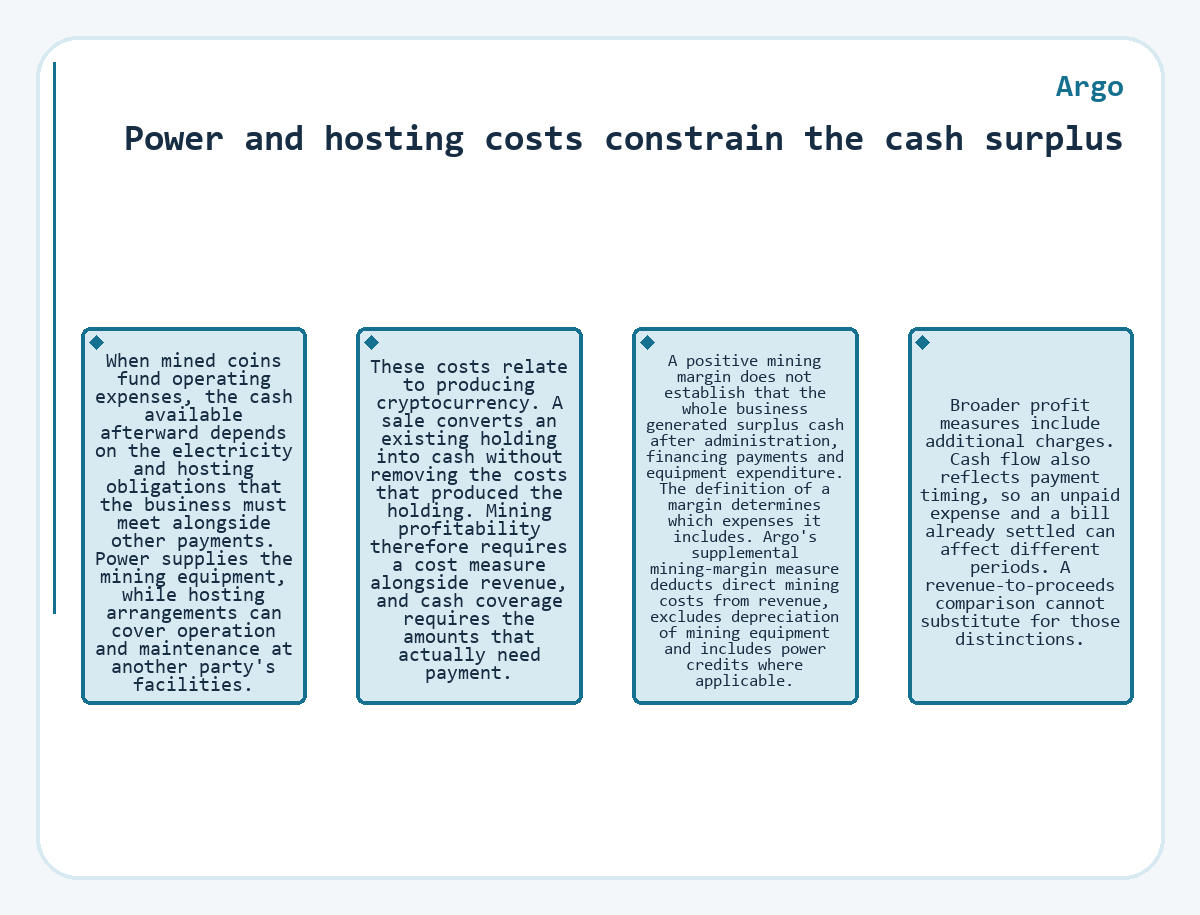
Power and hosting costs constrain the cash surplus
When mined coins fund operating expenses, the cash available afterward depends on the electricity and hosting obligations that the business must meet alongside other payments. Power supplies the mining equipment, while hosting arrangements can cover operation and maintenance at another party's facilities. These costs relate to producing cryptocurrency. A sale converts an existing holding into cash without removing the costs that produced the holding. Mining profitability therefore requires a cost measure alongside revenue, and cash coverage requires the amounts that actually need payment.
A positive mining margin does not establish that the whole business generated surplus cash after administration, financing payments and equipment expenditure.
The definition of a margin determines which expenses it includes. Argo's supplemental mining-margin measure deducts direct mining costs from revenue, excludes depreciation of mining equipment and includes power credits where applicable. Broader profit measures include additional charges. Cash flow also reflects payment timing, so an unpaid expense and a bill already settled can affect different periods. A revenue-to-proceeds comparison cannot substitute for those distinctions.
Why can coin-sale proceeds differ from mining revenue?
Coin-sale proceeds can differ because the company sells a different quantity or mix of coins from those earned during the reporting period, at different prices. Mining income follows the service period. Sales follow disposal dates. Matching the calendar window alone does not establish that both figures describe the same cryptocurrency.
Holdings carried into a period can contribute to its sale proceeds even though the associated mining revenue belongs to an earlier period. Conversely, coins earned near period end can remain unsold. That produces recognized income without a corresponding cash sale within the same reporting window.
Prices can also move between the daily mining valuation and the sale. A higher sale price increases proceeds for a given quantity; a lower price reduces them. The direction of that movement cannot be inferred from a period-end quotation when sales occurred on other dates.
Selling expenses affect the amount available from conversion into cash. Gross transaction value and cash received after charges describe different amounts. Their treatment in the reported proceeds line must remain consistent throughout a comparison. A fee deducted from settlement should not also be subtracted as though it remained unpaid.
Other disposals matter too. Coins that settle an operating bill reduce holdings without creating fiat sale receipts. The difference between revenue and proceeds consequently cannot, by itself, identify a trading gain, missing cash or weaker mining output. Coin quantities, prices and disposal types together help explain the difference.
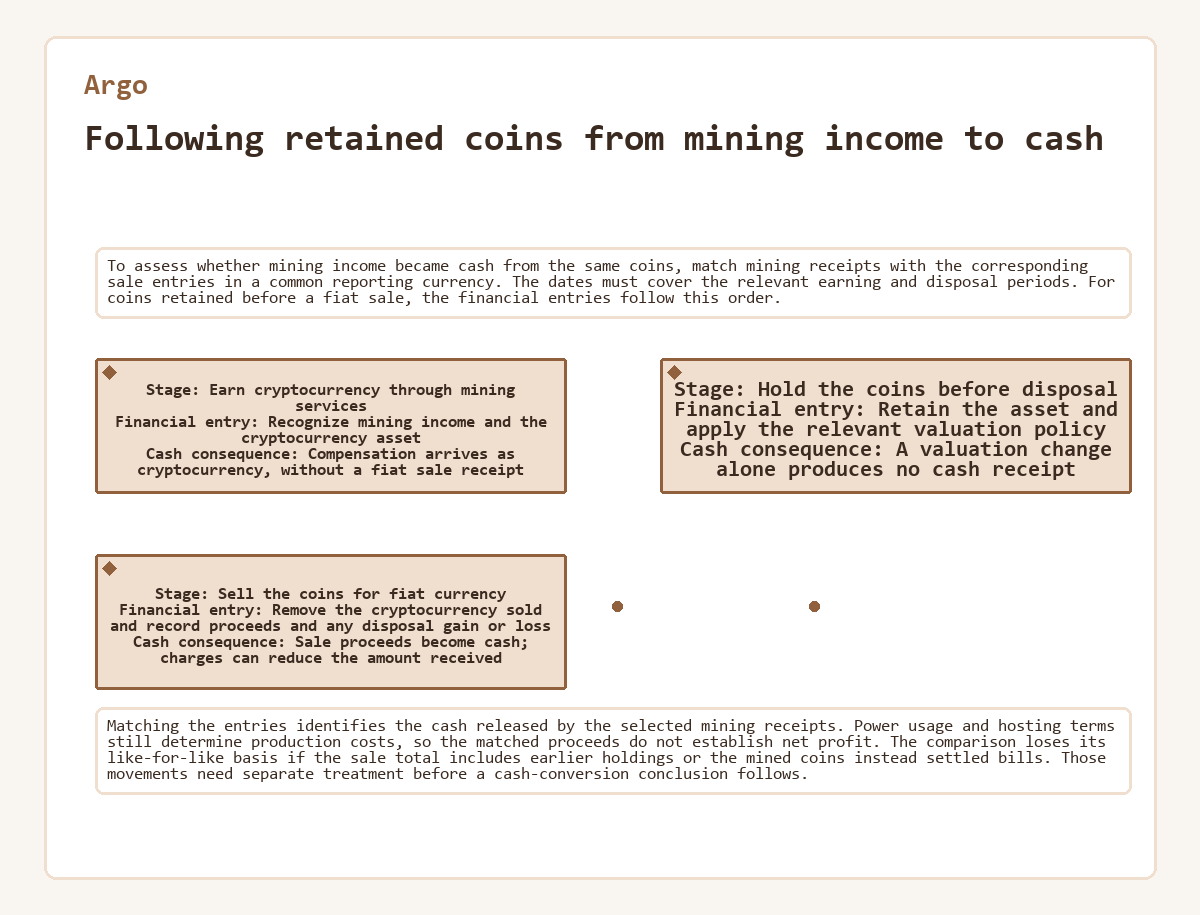
Following retained coins from mining income to cash
To assess whether mining income became cash from the same coins, match mining receipts with the corresponding sale entries in a common reporting currency. The dates must cover the relevant earning and disposal periods. For coins retained before a fiat sale, the financial entries follow this order.
| Stage | Financial entry | Cash consequence |
|---|---|---|
| Earn cryptocurrency through mining services | Recognize mining income and the cryptocurrency asset | Compensation arrives as cryptocurrency, without a fiat sale receipt |
| Hold the coins before disposal | Retain the asset and apply the relevant valuation policy | A valuation change alone produces no cash receipt |
| Sell the coins for fiat currency | Remove the cryptocurrency sold and record proceeds and any disposal gain or loss | Sale proceeds become cash; charges can reduce the amount received |
Matching the entries identifies the cash released by the selected mining receipts. Power usage and hosting terms still determine production costs, so the matched proceeds do not establish net profit. The comparison loses its like-for-like basis if the sale total includes earlier holdings or the mined coins instead settled bills. Those movements need separate treatment before a cash-conversion conclusion follows.
Daily prices attach revenue to the mining period
A daily valuation preserves the price associated with mining receipts, so the period's income does not use a later sale price for every coin. Argo's daily fair-value calculation multiplies the cryptocurrency received by its market price on the receipt date. Revenue recognition follows delivery of mining services, which generally coincides with coin receipt. Aggregating those daily values preserves differences in output and price across the period. Multiplying all production by a closing quotation would measure something different.
Holding gains and disposal gains affect different amounts
For cryptocurrency held as current assets at a reporting date, Argo's revised policy in its 2025 annual financial statements measures fair value and recognizes changes directly in profit or loss for that period. Fair value reflects a market-based measurement at the valuation date. It does not require an actual sale. A rise in the recorded value can therefore increase reported profit while the company continues holding the coins. The carrying amount is the asset's recorded value, which a subsequent disposal uses to calculate its gain or loss.
On disposal, the difference between proceeds and the carrying amount enters profit or loss. Earlier valuation movements can already have affected that carrying amount. The disposal gain therefore need not equal the entire movement since the coins were first earned. Keeping holding changes separate from disposal changes prevents the same price movement from being counted twice. Neither accounting entry establishes that the eventual sale covered the costs of mining the coins.
Coins used for power payments bypass a cash sale
When cryptocurrency directly settles a power bill, it discharges an operating obligation without generating the fiat receipts that a sale for cash would produce. In the first half of 2025, Argo reported US$3.013 million of power costs paid with digital assets. That period also recorded US$6.281 million of digital assets earned and US$3.155 million of proceeds from digital-asset sales. Each amount describes a different activity. The power payments help explain why examining cash sales alone misses a use of earned cryptocurrency.
These figures do not establish that the difference between earnings and sales consisted entirely of power payments. Opening holdings, remaining coins and valuation differences also matter.
Cash-flow presentation separates coin income from cash receipts
In an indirect cash-flow statement, noncash mining income needs an adjustment because recognizing cryptocurrency earnings does not itself create a fiat cash receipt for the business. Argo's 2024 cash-flow statement deducted revenue from digital assets within the operating reconciliation. It presented proceeds from digital-asset sales within investing activities.
Payment timing and changes in receivables or payables also affect cash flow. Depreciation changes accounting profit without requiring an equivalent cash payment in that period. Financing receipts and loan repayments belong to different activities again. Closing cash reflects all the relevant movements, so neither mining income nor coin-sale receipts alone can explain the bank balance.
Reporting currency and coin quantities determine comparability
When amounts use different currencies or unit scales, their apparent gap can change even though the underlying mining output and cryptocurrency disposals remain exactly the same. A statement expressed in thousands of US dollars requires consistent scaling before comparison with figures expressed in millions. Translation between reporting currencies can introduce a separate exchange-rate effect. That effect must remain distinct from a change in the cryptocurrency's own price. Otherwise, a currency movement can be mistaken for a change in mining performance.
Coin units and monetary values also answer different questions. The closing value of cryptocurrency holdings incorporates both quantity and valuation. A lower asset value does not necessarily establish that more coins were sold. Compatible comparisons retain the same reporting window, currency and definition of production. Aggregate Bitcoin-equivalent measures, when used, also need their stated conversion basis before comparison with a count of Bitcoin actually mined.
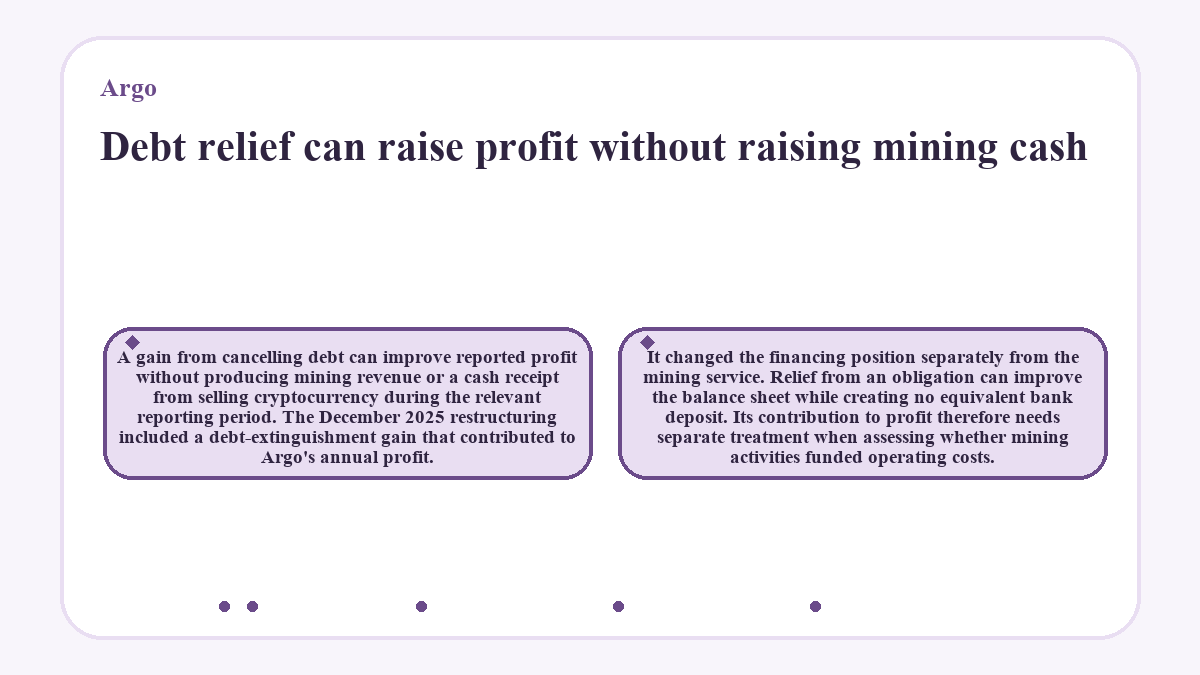
Debt relief can raise profit without raising mining cash
A gain from cancelling debt can improve reported profit without producing mining revenue or a cash receipt from selling cryptocurrency during the relevant reporting period. The December 2025 restructuring included a debt-extinguishment gain that contributed to Argo's annual profit. It changed the financing position separately from the mining service. Relief from an obligation can improve the balance sheet while creating no equivalent bank deposit. Its contribution to profit therefore needs separate treatment when assessing whether mining activities funded operating costs.
Cash coverage follows from receipts and payment obligations
The next question is whether cryptocurrency earnings and available cash can cover the business's payment obligations without relying on additional financing or disposals of assets other than mined cryptocurrency. Revenue describes earnings, and coin-sale proceeds describe one source of cash. Cash coverage also requires the payments due for running the business and maintaining its equipment. Borrowing or issuing shares can supply money while mining operations consume it. Those inflows explain liquidity, yet they do not establish that mining covered its own costs.
Separating recurring cash generation from financing support makes changes in liquidity easier to interpret, particularly when payment deadlines differ from mining and sale dates.
Argo - your questions answered
Does revenue per Bitcoin mined reveal the average price of coins sold?
Revenue per Bitcoin mined is a production-based ratio, not an average selling price. It divides the relevant mining revenue by the reported production quantity. An average sale price instead relates sale proceeds to the quantity sold, with consistent treatment of charges. Earlier holdings and coins retained or used for payments can make those denominators different.
Are Bitcoin transaction fees the same as mining pool charges?
Bitcoin transaction fees and mining pool charges have different roles in mining compensation. Network users pay transaction fees that contribute to miner rewards. Under Argo's disclosed Full Pay Per Share arrangement, estimated transaction fees contribute to the pool-payment calculation, while a pool discount reduces compensation. These amounts are distinct from charges associated with selling the cryptocurrency.
Can swapping mined cryptocurrency create fiat cash proceeds?
An exchange of mined cryptocurrency solely for another cryptocurrency does not create fiat cash proceeds. It changes the asset held and may have accounting consequences, but no cash is received from that exchange alone. Cash-sale proceeds require a disposal that actually produces cash, so a cryptocurrency conversion cannot automatically be included as a fiat receipt.
Do sales of mining machines count as mining revenue?
Proceeds from disposing of mining equipment are separate from revenue earned by providing mining services. Equipment sales release cash from a physical asset, and any disposal gain or loss follows the equipment's carrying amount. They can improve liquidity while reducing productive assets, so they should remain distinct from cryptocurrency-sale proceeds when assessing cash generated by mining.
Is a loan secured by coins equivalent to a coin sale?
A collateral pledge alone does not generate coin-sale proceeds. Cash received from drawing a loan is a financing inflow, with an associated repayment obligation. The pledged cryptocurrency supports that obligation under the loan terms. Any later sale or enforcement affecting those coins is a separate event whose accounting depends on what actually occurs.
Will lower depreciation increase the proceeds from selling mined coins?
Lower depreciation does not itself increase cryptocurrency-sale proceeds. Depreciation allocates equipment costs to accounting periods, while sale proceeds depend on the cryptocurrency disposed of and the sale terms. A smaller depreciation charge can improve reported profit without creating a corresponding cash receipt or changing the amount received from a coin sale.
Do Argo shareholders receive cash each time mined coins are sold?
Cash from coin sales belongs to the company and does not automatically pass to shareholders. A dividend involves a separate corporate distribution decision and payment. Sale receipts can instead fund operating bills, debt obligations or other business needs. Receiving cash from disposing of coins therefore does not establish a dividend payment.